
 +86 0(20) 8488 0520
+86 0(20) 8488 0520

For retail project managers and visual merchandising teams, a store rollout is a race against the clock. While the initial unit price of a display fixture is easy to calculate, the hidden costs—specifically installation labor and post-launch rework—are where budgets often spiral out of control.
When it comes to retail signage, illuminated displays are critical for brand visibility. Choosing the right light poster board isn't just an aesthetic decision; it's a strategic move to safeguard your project timeline and bottom line. Here is a comprehensive guide on how optimized LED signage solutions eliminate rework and drastically cut installation costs.
In global retail rollouts, the cost of the hardware is often dwarfed by the cost of the electrician and installation crew. Complicated wiring, misaligned frames, or uneven lighting require on-site troubleshooting, driving up hourly labor costs.
Worse is the cost of rework. If an LED light box sign fails two months after the grand opening, the brand must pay for a technician to travel to the site, dismantle the display, and replace the parts—often disrupting store operations. High-quality display LED light boxes are engineered specifically to prevent these scenarios through plug-and-play designs and rigorous quality control.
At Citylux, we always tell our retail clients that a slim light box is only as good as the time it saves on-site. If a display takes two hours to assemble instead of 20 minutes, the initial savings are already lost.
Modern retail environments require modularity. The transition from heavy, rigid signage to solutions like Edge-lit LED Light Box (PET Graphics) has revolutionized installation speeds.
Tool-Free Assembly: Premium poster light boxes feature aluminum frame profiles that lock together intuitively.
Simplified Graphic Updates: Store staff—rather than expensive contracted installers—can swap out PET graphics in minutes without any specialized tools.
Plug-and-Play Electrical Components: DC Female Connector with standardized eliminate the need for complex on-site soldering or electrical guesswork.
|
Comparison Item |
Ultra-Thin LED Light Box |
Magnetic Light Box |
Fabric Tension Light Box |
Snap Frame Light Box |
|
Overall Thickness |
10-14mm slim aluminum profile, suitable for modern retail interiors and space-limited locations |
Usually thicker because of the magnetic front panel structure |
Normally thicker due to the aluminum profile and fabric tension system |
Thicker frame structure with four opening sides |
|
Visual Appearance |
Clean, minimalist and premium appearance |
Simple appearance, but the front cover may look heavier |
Professional large-format appearance with frameless fabric graphics |
Traditional advertising frame appearance with visible snap edges |
|
Graphic Material |
Backlit film, poster or printed graphic(PET or PVC) |
Backlit film or poster |
Silicone-edge fabric graphic |
Backlit film or paper poster |
|
Graphic Replacement |
With a pull-out, slide-in design, graphics can be changed easily in just one minute. |
Easy replacement by removing the magnetic front panel |
Fabric must be inserted into the frame groove around all four sides |
Four frame edges must be opened and closed separately |
|
Replacement Efficiency |
Suitable for frequent promotions and regular campaign updates |
Convenient, but large magnetic panels may be difficult to handle |
More time-consuming, especially for large displays |
Easy for small sizes, but slower for multiple units |
|
Lighting Uniformity |
Light guide plate (LEP) Light guide plate provides even illumination in a slim structure |
Lighting performance depends heavily on the internal light source arrangement |
Excellent uniformity for large-format graphics |
Good illumination, but edge shadows may appear in lower-quality models |
|
Best Application |
Retail stores, restaurants, salons, shopping malls, exhibitions and commercial poster displays |
Indoor advertising locations requiring magnetic front access |
Large retail walls, exhibitions, showrooms and brand image displays |
Public information boards, cinemas, corridors and traditional poster advertising |
The number one cause of rework in illuminated signage is component failure—whether it's a dead LED chip, an overheated power supply, or inconsistent color temperatures (binning issues) that make brand colors look off.
Eliminating these issues starts long before the product leaves the manufacturing facility. It requires strict adherence to industrial-grade testing.
At CITYLUX, every advertising LED light box undergoes a defined quality-control process before shipment. Each unit is first inspected for frame dimensions, surface finish, wiring integrity, connector security, graphic alignment, and overall assembly quality. The completed light box then undergoes a 12 hour continuous aging test at 7W rated power to identify early LED failure, driver instability, abnormal heat generation, flickering, and brightness degradation. During the aging test, the operating temperature of the LED modules, power supply, aluminum frame, and internal wiring is monitored, with the maximum permitted temperature set at 45°C.
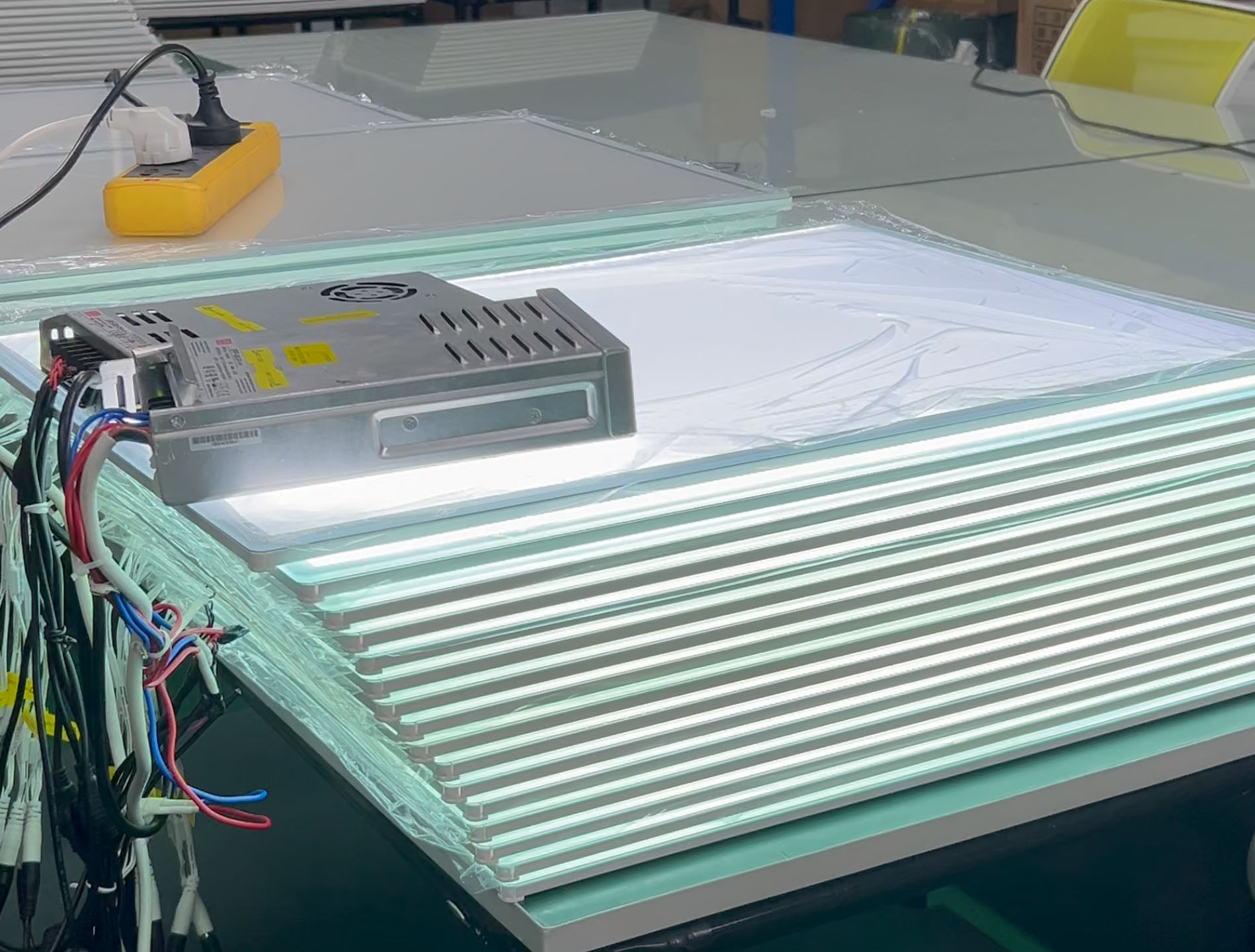
To maintain consistent lighting performance across different production batches, CITYLUX uses an integrating sphere and spectrometer to measure correlated color temperature (CCT), color rendering index (CRI), luminous flux, power consumption, and luminous efficacy. The target color temperature is controlled within 8000±1000K, while batch-to-batch color consistency is maintained within SDCM ≤ 5. The minimum CRI requirement is Ra ≥70, and the permitted brightness variation between finished light boxes is limited to ±10%. These measurements help ensure that multiple light boxes installed in the same retail store, restaurant, exhibition booth, or chain-store project deliver a consistent visual appearance.
For temperature reliability, samples are tested in a controlled environmental chamber at –25°C for 12 hours and +45℃ for 12 hours, by three temperature cycles between the defined minimum and maximum temperatures. After testing, the light box must start normally and show no visible deformation, frame separation, LED flickering, color shift, electrical failure, or significant reduction in brightness. Where required, CITYLUX also conducts a humidity test at 35°C and 80% relative humidity for 12 hours to evaluate insulation performance, corrosion resistance, and electrical stability.
Electrical safety testing includes an input power check, grounding continuity test, insulation resistance test, and dielectric withstand test. The insulation resistance must be at least10MΩ, while the product is tested at 1500V AC for 60 seconds without electrical breakdown or flashover. The grounding resistance is controlled below ≤0.5Ω, and the leakage current must remain below 2mA. For customized products, the voltage, plug type, power supply, cable length, dimming system, and electrical configuration are verified against the approved order specification before production release.
Before packing, CITYLUX performs a 100% final inspection covering illumination uniformity, dark spots, visible LED dots, frame scratches, poster-changing function, accessories, labeling, packaging, and carton protection. The permitted illumination uniformity is ≥ 80%, calculated from multiple measurement points across the illuminated surface. Products that do not meet the approved performance or appearance criteria are rejected or reworked before shipment. This structured testing process helps CITYLUX provide reliable light box sign with consistent color, uniform brightness, stable electrical performance, and reduced after-sales risk for B2B lighting projects.
Damage during transit is a massive driver of unexpected rework and delayed store openings.
Experienced B2B suppliers understand that packaging engineering is just as important as product engineering. Flat-pack shipping for large-format LED frames not only protects the aluminum extrusions but also drastically reduces volumetric weight, saving on global freight costs.
CITYLUX places each fully packed custom LED light box neatly on reinforced wooden pallets, then secures the load with protective corner guards, stretch film, and heavy-duty straps. Our experienced loading team arranges the cartons efficiently to maximize container space, reduce freight costs, and prevent movement during transportation. This palletized packing method provides reliable protection and helps maintain a very low damage rate during international shipping.
Theory is good, but executed projects prove reliability. Managing a rollout of 500 store locations requires a supplier capable of maintaining zero tolerance for failure across massive production runs.
A European retail customer found that the original brightness of our ultra-thin LED light box was too high for its store environment. After receiving the feedback, CITYLUX immediately worked with our electronic engineers to reduce the LED strip power and customize the light output. The optimized light boxes met the customer’s visual requirements, and reduced the after-sales issue rate by 40% compared with the previous solution.
When evaluating quotes from different manufacturers, B2B buyers must look at the Total Cost of Ownership (TCO). A quote that is 10% cheaper but lacks proper thermal management or uses low-CRI LEDs will ultimately cost the retailer significantly more in brand dilution and replacement labor.
CITYLUX quotations cover more than the light box itself. Each solution includes reliable power supplies, controlled batch-to-batch color consistency, uniform illumination, and a durable structure designed to reduce installation problems and on-site maintenance. By lowering failure risks, replacement costs, and after-sales expenses, CITYLUX LED light boxes provide better long-term value and a more cost-effective choice for B2B retail display projects.
Planning a successful retail signage rollout means designing for reality: installers are expensive, shipping is rough, and store downtime is unacceptable. By partnering with a manufacturer that prioritizes smart structural design, rigorous quality control, and intelligent packaging, retail brands can eliminate the headache of rework and dramatically lower their actual project costs.
Looking for a reliable signage partner for your next retail rollout?
Contact the Citylux team today to discuss your project requirements, request a sample, or get a detailed technical consultation.


 Servicio en línea
 +86 0(20) 8488 0520
 sales@cityluxled.com
 +8613640601669

